
And all I got was this stupid photo.
When Universal Studios Orlando announced their lineup for their 2025 Halloween Horror Nights haunted houses, there seemed to be something for everyone. Classics like the Jason Universe saw massive positive reception, as well as new age cult classics like the Terrifier series. For primarily younger horror demographics, however, one name immediately stuck out like a sore thumb: Five Nights at Freddy’s. This haunted house would allow parkgoers and fans alike to step inside the world of the video game (though, this and the Fallout haunted house were mainly inspired by their adaptations) and see its elements up close in person for the first time. Fully moving animatronics on the main stage, the security office, the kitchen, and maybe even the man behind the slaughter himself. Anyone who was there in the series’ early days, especially little kids, had the same collective thought back in the day: it would be so cool to go to a real-life version of this place. You know, preferably without the haunted animatronics and risk of being shoved into a springlocked Freddy Fazbear suit, but you get the gist. This was quite literally a dream come true for so many fans, young and old. So when I found out I’d be going to Universal Studios Orlando right in the nick of time, I knew I couldn’t pass up this opportunity.
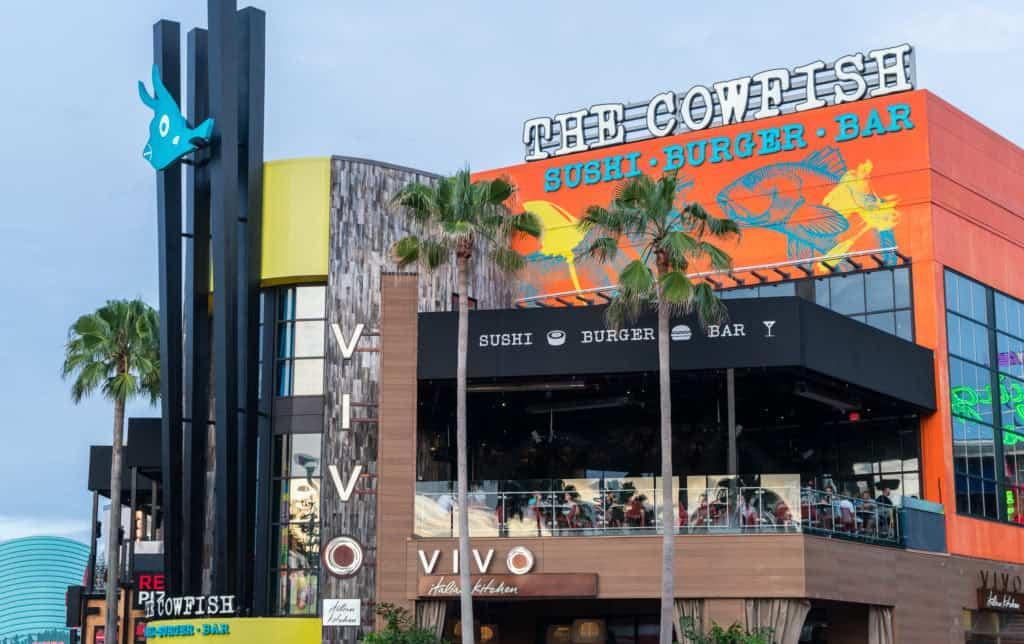
We arrived at the city walk at around 4:30 from our shuttle (Epic Universe is great, by the way. Definitely go there.) and stopped for some dinner beforehand. Picking whatever the first place we saw was, we ended up at The Cowfish, a strange fusion restaurant combining sushi and burgers in their signature dish dubbed the “burgushi”. None of this plays into the Five Nights at Freddy’s part of this story, but it’s important to me that you know this. Across from the restaurant was one of Universal Studios Orlando’s many stores, where they had a Freddy Fazbear decal right in the window alongside plushies of the main four inside. They meant business, and knew exactly what many young people were there for.
Advancing to the haunted houses through the Halloween Horror Nights gates leading to the main park, we followed the signs leading us to the haunted houses. The line for the Five Nights at Freddy’s haunted house was held in what I assumed was the former sound stage of many Universal productions. As it turns out, the whole of Universal Studios Orlando’s studio lot theming is actually ripped from Universal Studios Hollywood, in which parkgoers can go on a tour of their real studio lots. So many iconic films were produced at that location in those very sound stages, and we were being held in a crowded replica full of tired, overheated, and possibly drunken Five Nights at Freddy’s fans.
After about an hour of standing around and slightly moving forward, we exited the sound stage in the final lane of its crowded line. Expecting to have been met with an entrance to the fictional 80’s entertainment center, we were instead shocked to find… another line. This one did not appear nearly as packed as the sound stage line, though not for lack of trying. This line stretched out and wrapped around multiple other sound stages outside the one we had just come from, and the sweaty Florida heat almost made this wait harder to bear. It took nearly ANOTHER hour before we found ourselves in the final lane of what we hoped was, dear God, the final line. Thankfully, we could see the residual glow of the neon lights through the back entrance we were being fed into. I hoped that in spite of the near two hours we waited in that sweaty, cramped, fatigued line that maybe, just MAYBE this haunted house would have been worth it. And before us, there it suddenly was.
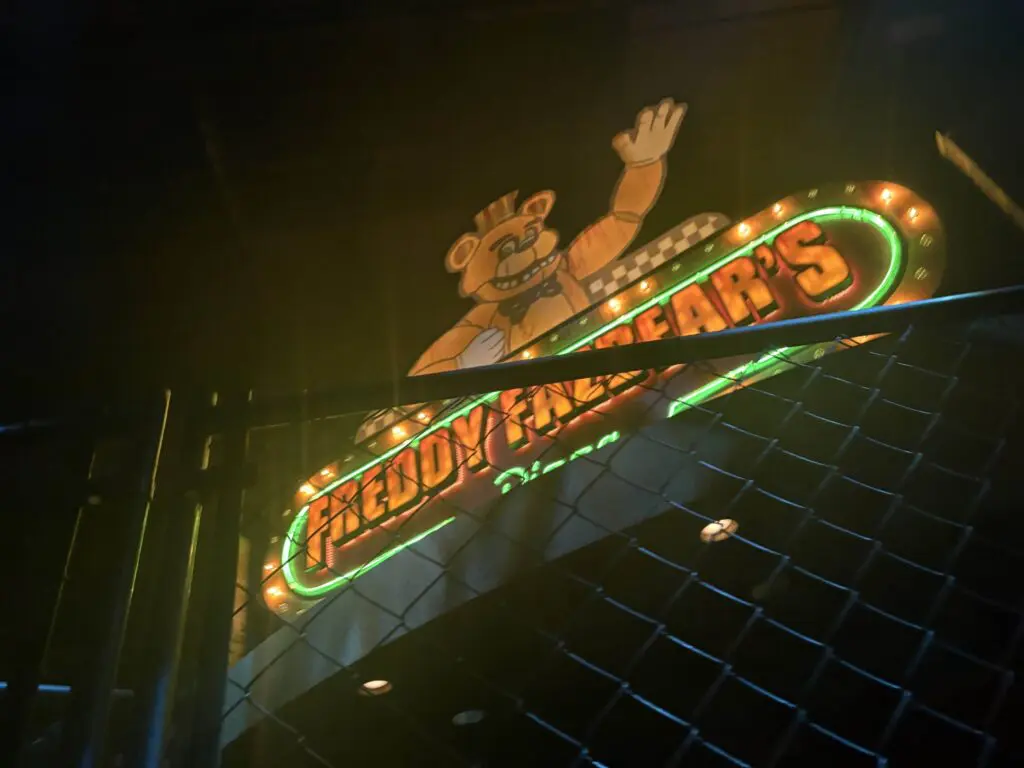
This was the only photo I could capture before they threatened to kick me out. We walked through the entrance, past the animatronics (singing “Talking In Your Sleep” by The Romantics like in the film), through the main office, past the kitchen, being jumpscared all the way throughout.
And then, it was done.
We were disappointed to say the least. I mean, all that waiting for THAT? We definitely set our expectations too high. I feel like any Halloween Horror Nights veteran would have known what to expect from the haunted houses at this point, but to someone new, ESPECIALLY following such a long line, it just felt a lot cheaper and quicker than we had expected. Then again, that’s kind of the fun of the franchise even from just the first game. My mind keeps going back and forth on if this was a waste of time or exactly what it needed to be, but to be honest, I’m overthinking this. It’s kind of in a Five Nights at Freddy’s fan’s nature to sweat the little details and go absolutely crazy trying to figure things out, and I’m not gonna be that guy. I’m not even going to complain about a lack of Golden Freddy representation—though the guy who will is probably out there somewhere, waiting with bated breath for you to ask him. In any case, it was both really cool to see one of my childhood fantasies finally realized in a material sense with the Five Nights at Freddy’s haunted house at Universal Studios Orlando, and something I’ll probably never go to again.
If you want to explore a haunted house of your own while at home this Halloween, come check out our title selection on our sister site Galxy.tv! Live in the moment with the found footage film 8213: Gacy House, as well as the chilling 100 Ghost Street: The Return of Richard Speck. Happy Halloween, everyone!
In a departure from our usual cinema-focused coverage, we occasionally take a look at gaming as a part of general entertainment news. Sometimes the two go hand in hand, with blockbuster adaptations like Sonic the Hedgehog 3 and A Minecraft Movie gaining news articles and reviews on this site in the past year, as well as gaming-adjacent general articles. Even the writer of our review of The Fantastic Four: First Steps gave a nod to Videocult’s Rain World in his comparisons, an indie game focused on exploring a desolate, fractured dark world left behind by calamity.
As far as dark, desolate, post-apocalyptic indies go, Team Cherry’s Hollow Knight is unquestionably one of the crown jewels. While the Kickstarter’s stretch goals didn’t quite go all the way as some other crowdfunded indies have, the Australian team of three made a meal out of their budget and then some, going on to sell over 15 million copies as one of the most successful indie releases of all time. And today, after over 7 years of development, the game’s sequel Hollow Knight: Silksong released on Steam. Have we gotten the chance to play yet?
To tell the truth, most players are still waiting.
Due to the incredibly high amount of buzz surrounding the game’s release, it’s important to understand just how many people were waiting on Silksong worldwide. In its pre-release phase, the game was wishlisted by upwards of five million users on the Steam platform, beating out other indie releases like Subnautica 2, AAA releases like Borderlands 4, and even Valve’s (the company who owns Steam) very own upcoming shooter, Deadlock. Needless to say, the overwhelming amount of people waiting in line for the next entry in the Hollow Knight series was impossible for any one server to handle, causing the Steam backend to return an error message upon continuing to purchase.
This is not limited to the PC storefront—a report from Eurogamer as well as numerous consumer tweets confirm that Xbox, PlayStation, and Nintendo eShop servers all crashed upon Silksong‘s release. Gamers from all over the world, no matter what platform, have all united today to support a grand journey eight years in the making, and those unaware will soon know. The current workaround some have figured out is purchasing a game key through Humble Bundle, activating the code through Steam after the fact and bypassing the checkout backend. Regardless, Hollow Knight fans worldwide will be able to purchase and play the game on the platform of their choice once the server errors with each are ironed out, possibly in the next few hours. We’ll see you in Pharloom!
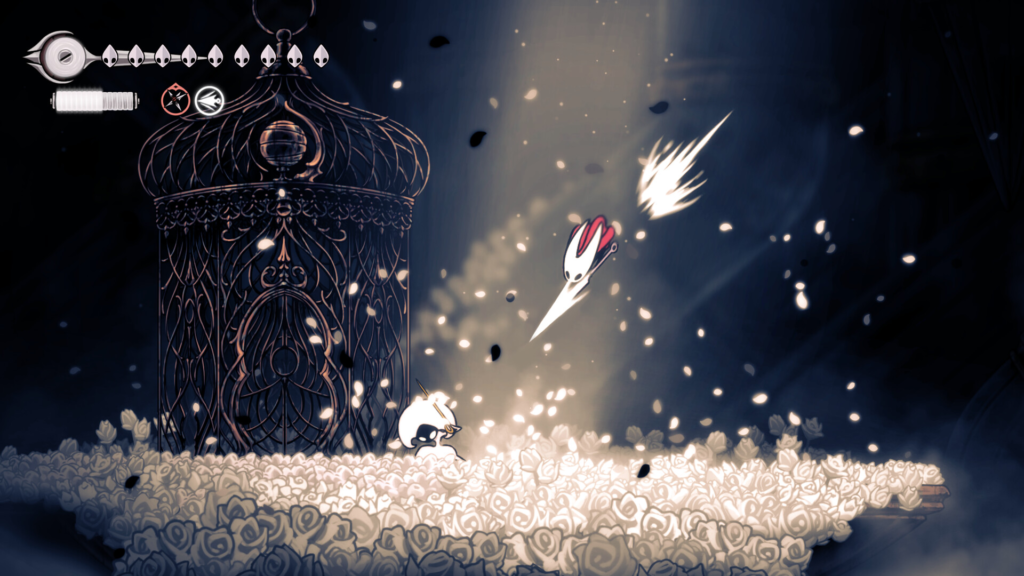
Hollow Knight: Silksong is now available on PlayStation, Xbox, and Nintendo Switch systems, as well as Xbox Game Pass and Steam.
Written by Parker Ashley
Edited by J. Nagle
The reboot of The Fantastic Four by Marvel Studios did not disappoint. The Fantastic Four: First Steps follows the team not only facing off against Galactus (Ralph Ineson) and Silver Surfer (Julia Garner), but the challenge of preparing for a new member of the family. It may not be a perfect film, but it sure as hell is a good ride. So buckle up and listen to my thoughts on The Fantastic Four: First Steps.
Abandon all hope ye who enter here: There will be spoilers ahead. If you haven’t seen the film yet and plan to, then don’t read ahead.
I’d like to start off with some of the things which I really enjoyed about the film, and there are a lot. I really enjoy the production design; the retro-futuristic aesthetic not only fits the film very well, but looks amazing. Retrofuturism has a soft spot in my heart and this movie pulls it off incredibly. I also really enjoyed the segment where the Fantastic Four are captured by Galactus’ ship. The scenes were really good on their own, but I loved the design of the ship itself. The vast industrial megastructure of Taa II tickles my brain in a way not many environments do. It may be a strange comparison, but a visually immersive environment like this reminded me of that which the game Rain World takes place in. The impossibly large brutalist structure of it, while not being as lively as that which the game portrays, has the same vibe as some of the more industrious parts of its map.
Another thing I really enjoyed was the dynamic between Johnny Storm (Joseph Quinn) and the Silver Surfer. Their interactions and relationship throughout the narrative was really well done in my opinion. Johnny Storm is an amazing character in general throughout the film and Joe Quinn gave a great performance. I don’t think I would enjoyed the movie nearly as much as I did if he didn’t commit to performing the character how he did, and he’s probably my favorite character in the film for that reason.
While this film is fantastic, I do have a few critiques in regards to it. One of my biggest problems with this film is the public’s reaction to Sue Storm (Vanessa Kirby) and Reed Richards’ (Pedro Pascal) decision not to surrender their baby. The outcry itself seems accurate and very well deserved in-universe, but the fact their later reaction amounts to “Oh, she’d move heaven and earth for us? It’s all good.” seems like lazy writing. She’s still putting the entire world at risk for her child, that’s one of the biggest stakes of the narrative. No speech would be able to change people’s minds like that.
Another small problem I personally have is that in both the comics and upon his introduction in the film, Galactus is portrayed as very powerful, having godlike powers and possessing the Power Cosmic. But when he gets to Earth, he just kinda… walks around? He can devour entire worlds, but he just walks around when he gets out of his chair? (Spoiler warning for Annihilation and The Mighty Thor Annual) In the comics, he has been shown to have destroyed three whole star systems and a majority of the gigantic Annihilation Wave in Annihilation. Keep in mind, he was in a weakened state when he did this. On top of that, the clash of power between Galactus, Scrier, and The Other was going to destroy The entire Multiverse, “Time and Space are bent to the breaking point, Reality itself groans like an ancient house about to collapse.” So how the hell did he get defeated by being pushed into a portal? To be fair, that’s just in the comics. Galactus as portrayed in the MCU is a different version compared to that as all MCU characters as, and even in the comics his power scaling is very inconsistent. Still, it feels like he didn’t even fight back when faced with a battle he should have had more than a chance in hell of winning.

Despite my criticisms, The Fantastic Four: The First Steps is an really enjoyable watch and I couldn’t recommend it more. If you haven’t seen it yet, definitely add it to your watch list. I give it a solid 8.5 out of 10!
Matt Shakman’s The Fantastic Four: First Steps is now playing in theaters worldwide.
by J. Nagle
Whether through its premise, direction, or overall tone, Zach Cregger’s Weapons has been making waves throughout theaters. Since its release on August 8th, the supernatural horror has grossed over $149 million in the box office, running laps around its $38 million budget. With an ensemble as well-cast as they are well-performed, it’s easy to see why the film has brought in so many cinemagoers—horror enthusiasts and rare horror viewers alike.
Zach Cregger (Barbarian, Whitest Kids U’Know) brings a unique direction to the table that stands out from much of today’s horror filmmaking, going back to a traditional classic style of horror narratives by combining mystery elements with the off-color humor that pioneered his comedy troupe, Whitest Kids U’Know. Incidentally, the WKUK YouTube page has already taken advantage of Cregger’s success by reposting a sketch to their YouTube channel from the season 2 premiere of their titular comedy show. In the sketch, Cregger plays a fictionalized version of himself directing a scene in which two detectives investigate a murder.
Weapons revels in a storytelling method that follows a series of accounts from one character to the next, concerning the same event and how it comes to its resolution. The accounts often take place concurrently with that which the audience has already seen, often offering a different angle or exposition on the circumstances of a given story beat. This allows for the narrative to stay fresh even in the case of repeating itself, a choice which feels more intentional than it initially lets on. This includes how one character may remember their actions versus how another experienced them, giving a glimpse into how certain characters in the ensemble cast may have viewed the phenomenon differently.
Beyond Weapons, Cregger and the rest of the WKUK troupe have previewed Mars at the Tribeca Film Festival in the past year, an animated sci-fi comedy that will be their final work as a group. This contains the final performance from the late Trevor Moore, the founder of WKUK who tragically passed away on August 7th of 2021, four years and one day prior to the release of Weapons. In an interview with GQ, Cregger describes the writing of Weapons in the wake of Moore’s passing as himself venting “about that overwhelming emotion you get when you lose someone close to you…[s]o he didn’t explode.” While Weapons is a far cry from the comedic endeavors Cregger and Moore would explore throughout their tenure with WKUK, elements of their humor seep through in some of the line deliveries and acting direction, making for a narrative that feels sincere, one that doesn’t feel like it talks down to its viewers.
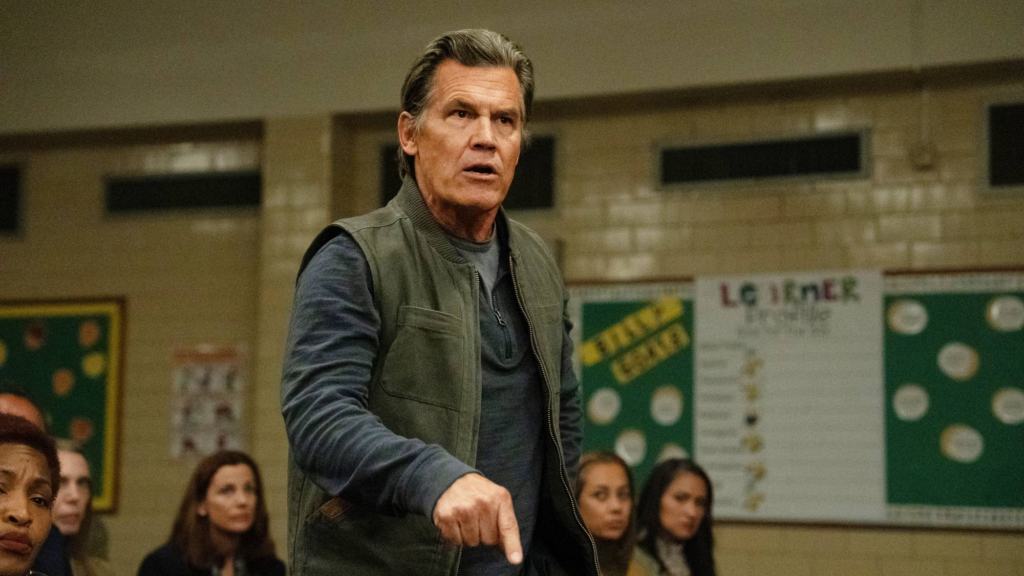
Weapons is now playing in theaters worldwide.
by Parker Ashley, edited by J. Nagle
In my opinion, James Gunn’s Superman is the best film to have come out in the past couple of years. It has a compelling storyline, action-packed fight scenes, incredible characters, beautiful cinematography, and one of my all-time favorite soundtracks for a movie. It may seem as though I’m overhyping the film, but I don’t think I’ve even scratched the surface of how truly fantastic this movie is.
I think the most important thing to highlight from this film is its heart. You can tell that this movie was made with a lot of love and passion. In almost every moment of this film, you can feel the heart of it.
Another aspect of this movie that I adore is the comedy. This film is one of the few movies that has been able to make me laugh in the theatre as of late. The comedy in the movie is able to keep it lighthearted, but also still keeps the serious tone of the film. They also never force the comedy into your face; it always feels very natural and not like it’s being shoved down your throat.
Abandon all hope ye who enter here: There will be spoilers ahead. If you haven’t seen the film yet and plan to, then don’t read ahead.

One of the parts of the movie that is a prime example of how amazing the comedy in this film is the scene where Mr. Terrific (Edi Gathegi) and Lois Lane (Rachel Brosnahan) are waiting for the garage door to open. The gag of it was obviously the door taking a long time to open, but it didn’t feel drawn out. It was longish, but it didn’t overstay its welcome. This scene was hilarious, but also a much-needed palate cleanser. It was able to lighten the mood in a part of the film which was intense, but it also didn’t ruin the seriousness of previous scenes. Another thing this scene does well is show some of the character of Mr. Terrific, who, as Lois Lane says, has a flying saucer, but couldn’t get a faster garage door. It shows that despite him being the brains of the Justice Gang, he isn’t perfect.
Lex Luthor (Nicholas Hoult) is by far my favorite movie villain of all time. His plans for the Boravian conflict and that he caused the Boravian conflict to kill Superman (David Corenswet), not the other way around, really showcased his hatred towards Superman and metahumans in general. His complete disregard for the destruction and loss of life is a stark contrast to Superman’s care for every single living thing. He started the Boravian conflict despite knowing many could die; he would’ve let the rift spread into an unevacuated area, while Superman even saves a squirrel because every single life matters to him. It showcases that Lex doesn’t care who will die or what will be destroyed; all he cares about is accomplishing his goal of killing Superman. Another scene that just showcases how great of a villain Lex Luthor is is his envy monologue. It is honestly one of my favorite quotes of all time. It is powerful, emotional, and amazingly delivered.

Lex Luthor reminds me of AM from Harlan Ellison’s I Have No Mouth and I Must Scream, specifically the BBC Radio Drama version. If you are not familiar with it, I strongly recommend listening to it, but the similarities between AM and Lex Luthor, while obviously not being the exact same, are extremely noticeable, at least to me. One of the examples of this is when Lex Luthor says, “Because his strength illuminates how WEAK we all really are! So, my envy is a calling! It is the sole hope for humanity, because it is what has driven me to annihilate you!” Much like how AM hatred is driven by his envy of humans’ bodies, senses, their ability to wander, and their tendency to hope, Lex Luthor’s hatred of Superman and metahumans in general is driven by his envy of Superman.
Another thing that I thought was amazingly done was the big twist that Superman’s parents sent him to Earth to conquer and preserve the Kryptonian race instead of being sent to help humanity. It’s an amazing twist on the classic Superman backstory. Also, the change from him listening to his Kryptonian parents’ message to videos of his Earth parents was a powerful and beautiful touch, one of the many moments of the movie that showed off the heart of the film.
Another aspect of the film I thought was really amazing was how human everything felt. The interactions between characters felt so real and natural. On top of that, the characters are all very unique and human. Think about characters like Eve Teschmacher (Sara Sampaio) and Mr. Terrific and even Superman, they all have flaws like Eve having “mutant toes”, Mr. Terrific is not as much of pacifist as superman and he doesn’t care much for people, and Superman who when was presented with the interview, ran away because he got upset and can come off as a little short sighted at times. These characters all have flaws, but that’s what makes them seem so human. None of the characters are perfect badass flawless people, they all have flaws and have imperfections, like Superman says, “I wake up every morning and despite not knowing what to do, I put one foot in front of the other and I try to make the best choices I can. I screw up all the time, but that is being human. And that’s my greatest strength.” Like being human is Superman’s greatest strength, I think it is also this film’s. The humanity of this film, along with its heart, makes it a truly amazing experience.

To wrap this review up, in my opinion, James Gunn’s Superman is the best movie that has come out in 2025. The story, the characters, the music, every part comes together amazingly well. It is a truly incredible film and has quickly become one of my favorite films of all time.
James Gunn’s Superman is now playing in theaters worldwide.
by J. Nagle
Early May saw the release of Andrew DeYoung’s Friendship through A24, starring Tim Robinson and Paul Rudd. The two actors have something of a cult following, the former being known for his over-the-top comedic performances in Netflix’s I Think You Should Leave and the latter in a multitude of comedies, as well as portraying Ant-Man in Disney’s Marvel Cinematic Universe. When on screen together in DeYoung’s directorial debut, they make for an absurd, unforgettable ride through the lives of two eccentric middle-aged men on two different—though not entirely incompatible—wavelengths.
With Robinson and Rudd’s unique and comedic chemistry throughout the film, it feels appropriate to question why the two haven’t co-starred in a segment of Robinson’s Netflix show before. Rudd is no stranger to the absurd in comedy, as can be seen in previous roles of his such as guest starring in Adult Swim’s Tim and Eric Awesome Show, Great Job! back in 2010. When the two meet on screen, their characters almost immediately click; the two strange men find comfort in their shared interest in the unusual around their small town. Part of the film’s fun comes from this varying level of respect between the two. Robinson’s character, Craig Waterman, finds himself with this almost parasocial bond between himself and this local weatherman he just met, played by Rudd. This weatherman, Austin Carmichael, fully acknowledges the instability of Craig as a person and their bond as a whole, but by the end of the film never fully loses this “respect”.
Friendship marks Paul Rudd’s second A24 excursion of the year, following Death of a Unicorn in which he co-starred with Scream’s Jenna Ortega as well as Will Poulter, recently known for his work in FX’s The Bear. The film so far has grossed over $15 million domestically in theaters, and will go on to earn more through today’s release of the film on digital platforms.

Friendship is now available for purchase and rental on Prime Video and YouTube Movies among other platforms, as well as select theaters across America.
Get Some Strange!