





And no, it’s not related to any of Valve’s alleged projects.
When Half-Life: Alyx released in 2020, it led to a subsequent renaissance of sorts of Half-Life and even Portal content. This wasn’t quite the Half-Life 2: Episode Three fans wanted—nor outright Half-Life 3—but it was finally a return to the universe in an all new engine, from a brand new perspective that offered a fresh but familiar take on the world. Though a bit inaccessible due to the pricey nature of VR technology and peripherals, Alyx has since been hailed as one of VR gaming’s essentials from release to a retrospective look, as well as an incredible return to form for Valve’s development branch.
So when datamines and leaks of Valve’s erroneously pushed files for an update contained references to files of a game that didn’t exist involving Half-Life‘s flagship HEV suit, as well as said game being a single-player non-VR experience, it’s fair to say speculation began to run rampant. This was only further fueled by the listing on a voice actor’s portfolio page that they had worked on an unknown Valve game(?) known only as “Project White Sands”. Fans of the franchise have taken into consideration that the aforementioned “white sands” could refer to snow, which can be found where Half-Life‘s arctic device known as the Borealis resides. As some long-time fans of Half-Life were quick to point out, the Borealis was to be a key point of Episode Three, being seen in some of the concept art which made it through to the public.
And then a website for a suspiciously named startup appeared.

Blackmesa.com is a real website for an actual biotechnology/science laboratory in Boston that just so happens to share the exact name and display a very similar logo to the one shown in-game, the website for which claims it has nothing to do with the series and yet contains an ominous countdown to September 30th, 2024 at the bottom. What is going on here? Is this an ARG planted by Valve to drum up discussion and hype around a potential shadowdrop of the next entry in the Half-Life series? It must be, there are too many coincidences. Why else would this show up as soon as the results of datamining and leaks pointed towards a new entry?
Well, ground yourself for a moment. After doing enough digging, it can be confirmed that the real Black Mesa IS an actual biomanufacturing startup, with a LinkedIn page and multiple verified appearances of its founder talking about exactly what he claims to do. If this is an ARG to drum up hype for Valve’s next big thing, it would have to be one of the longest-running, expensive, effort-filled marketing campaigns in history, full of aliases and personas for real people to take on for over a decade. Though, any astute observer of the developer knows the production of anything related to Half-Life since the release of Episode Two has been a rough and troubled pipeline.
While their company names are identical and their logos may have similar fillings with different shapes, this realistically seems just like CEO Charles Fracchia is one of the many loyal fans of the series who wanted to pay homage while doing something similar to the in-game company that he happens to also be very passionate about. It’s not impossible to see a cross-promotion happening between the company and Valve in regards to SOMETHING Half-Life related, but sending thousands of emails to a small startup asking for help fighting the Combine isn’t going to help things. I do think it’s a bit suspicious that Valve hadn’t locked down the domain name for Black Mesa years ago as well, but there are too many real ties involved in all of this to say with certainty that it’s all a decades-long front for a game that many had long since given up on before the announcement of Alyx.

When in discussion about the works of LAIKA and Henry Selick alike, 2009’s Coraline is often pointed to as one of the crown jewels of both, and for good reason. Its portrayal of the uncanny using such a raw medium as stop-motion animation to tell its imaginative story made for a film unlike any other releases of the year, and definitely one that stuck in the minds of those who watched it in their youth. Now, the film celebrates its 15th anniversary with a theatrical re-release containing a behind-the-scenes featurette after the credits roll. With how much most of its living audience grew up in the time since then, it appears many are flocking to their local theater for a showing, in addition to those who discovered the film after the fact and want to finally see it on the big screen as it was intended.
Theatrical re-releases have had their supporters and critics, especially with the increased practice in the last few years by bigger companies than Focus Features. Disney is one of the biggest companies partaking in this strategy, re-releasing everything from Star Wars films to Pixar and their own animated selections. To be fair, some films such as Turning Red, Soul, and Luca had their opportunity for a theatrical release stripped for safety reasons during the COVID-19 pandemic, so this strategy is neat for specifically those films as they are able to receive that closure. As far as some of the other re-releases go, however, it’s felt a bit like Disney has been chasing their own glory and looking for what works after their recent animated features and Star Wars projects have flopped critically and/or commercially. Though, looking at some of the box office returns of these re-releases, it’s hard to say they’re moving in the right direction.
And yet, despite how much bigger of a corporate presence Disney casts over the film industry than a distributor like Focus Features, Coraline‘s 3D re-release has grossed over $12 million in the US, expanding to $20 million worldwide in its opening weekend, making it one of the most successful re-releases of any movie to date. This is already impressive in the face of the many other re-releases this year, but even moreso when taking into account that this $20 million outnumbers the $16 million opening weekend Coraline opened to in the US in 2009.
Laika’s productions are always nothing but soulful. Even in the face of lesser box office returns on new films than most major distributors, their method of storytelling, aesthetics, and heart have cemented them as one of the most beloved production companies of animated films. My hope is that this re-release of one of their greatest achievements drums up talk of the company name again, resulting in a bigger audience being drawn to their next original film Wildwood.
Coraline is now playing, again, in theaters.

Borderlands is the latest film at the butt of cinemagoers’ jokes, along with Harold and the Purple Crayon if anyone was even slightly passionate about that one. Being described as laden with bad acting, directing, and action sequences all topped off with ho-hum box office returns in its opening weekend, Borderlands adapts the titular video game to the worst of its ability. Even early on, the film was notorious for its troubled production. The most infamous “fun fact” the movie’s production has to offer is that Eli Roth’s direction and changes were so polarizing that screenwriter Craig Mazin refused to have the film on his record, crediting his contribution to the alias of “Joe Crombie”. Now that the film has released and everyone is calling it worse than Madame Web of all things, we had to check it out to see if that much really was true.
It wasn’t.
Listen, Borderlands is definitely one of those “nothing” movies. It feels uninspired—ironically, too, being an adaptation—the writing has issues for sure, and a lot of the direction feels messy and all over the place. If you’re looking for problems with the film, you’ll definitely find them, whether or not you’ve actually indulged in or are a fan of the Borderlands series going in. But aside from that, there’s nothing in the film that feels like it actively harms the medium or genre and how far both have come. Madame Web was special in that absolutely NOTHING about it was working. For people who love to see absolute trainwrecks at the theater, its release was a dream come true. What’s special about Borderlands, weirdly enough, is that it ISN’T special. It’s a bad movie, but not unwatchable in the way some of the more recently shunned releases have been.
In spite of its sloppy direction, the palette of the movie can be pleasant to look at, which is a good explanation for how the movie as a package feels. Interesting to look at, but boring to watch. Some of the characters’ motivations, even that of the main cast we follow, aren’t as clear as they should be for a film where all these rogues are together for a reason. Adding onto that, it’s not entirely entertaining watching the main cast’s interactions, as they’re not written to have the chemistry required for film like this where a bunch of morally grey strangers band together against a much bigger evil. James Gunn’s original Guardians of the Galaxy had it figured out, as well as his take on The Suicide Squad (the standalone follow-up to the similarly titled original that ALSO couldn’t do much right). It’s not like it’s an easy task to pull off, especially when most of reviewers’ comparisons to a group that does this dynamic better usually comes down to comparing to Gunn’s work. What I find hard to believe, though, is that Craig Mazin’s script didn’t do this a whole lot better.
A lot of this film felt rushed and troubled, from the CGI to the marketing to the line deliveries, we could definitely go on. After how mediocre a lot of the other loadbearing terrible films were this past year, though, it’s hard to say this one breaks the mold. It’s just a generic action movie that doesn’t do anything all too inventive or impressive that you could probably just throw on if you need something to watch. Again, you’ll find problems no matter if you’re actively looking or not. But with the reputation the film has already accrued, it’s pretty hard to go in expecting anything anymore if you happen to find it on digital in the future, or in the bargain bin.

Borderlands is now playing in theaters worldwide.
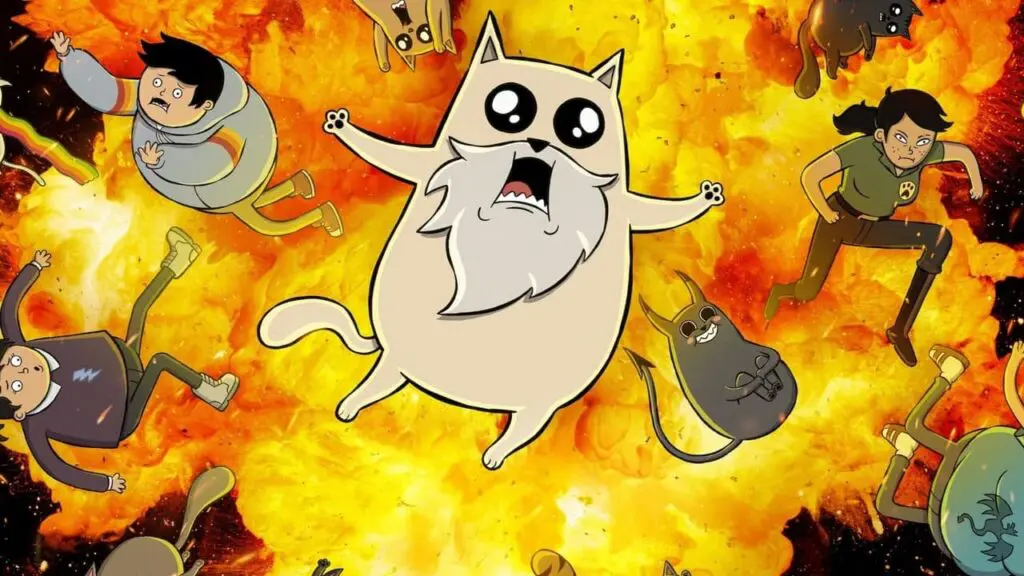
Exploding Kittens is a name any player of party games has at least heard in passing. The breakout Kickstarter hit has become a full franchise with expansions, spinoff games and ports, and now an entire TV series since its launch in 2015. The series feels a bit like it came out of nowhere, since I’d hardly heard anything much about it before the entire season release this past July. The first looks posted to Twitter seemed not to garner much attention—though, to be fair, that’s not exactly the series’ or Netflix’s fault so much as it might be its notorious owner’s for driving everyone away.
A lot of Netflix’s animated sitcoms tend to blend together for me. Paradise PD, Farzar, and Hoops (to name a few) all have these shared stylistic traits so prevalent in attempted new animated sitcom programming that they seem a bit creatively limited and fail to stand out from themselves. Netflix’s new sitcom, Exploding Kittens, escapes this stylistic box with its best attempt at blending rigged animation and the original artist Matthew Inman’s style for the game. While it’s not the most thrilling to look at, it’s easy to understand that as being the point of the series’ stylistic choices. This is where the show gets a bit divisive in its choices, because it feels less like an adaptation of the Exploding Kittens game and more like an animated successor INSPIRED by the game.
When God and the Devil are booted from their respective afterlives in order to live among humans for a bit to learn how to work managing them into their actual jobs, they’re sent to the planet in the form of small felines, Godcat and Devilcat respectively. These two now have ACTUAL cards with the help of a tie-in spin-off game, Good vs. Evil. The only pre-existing Exploding Kittens character who takes on a recurring role in the show is Marv’s boss, who oddly enough appears on one of the Alter the Future cards.
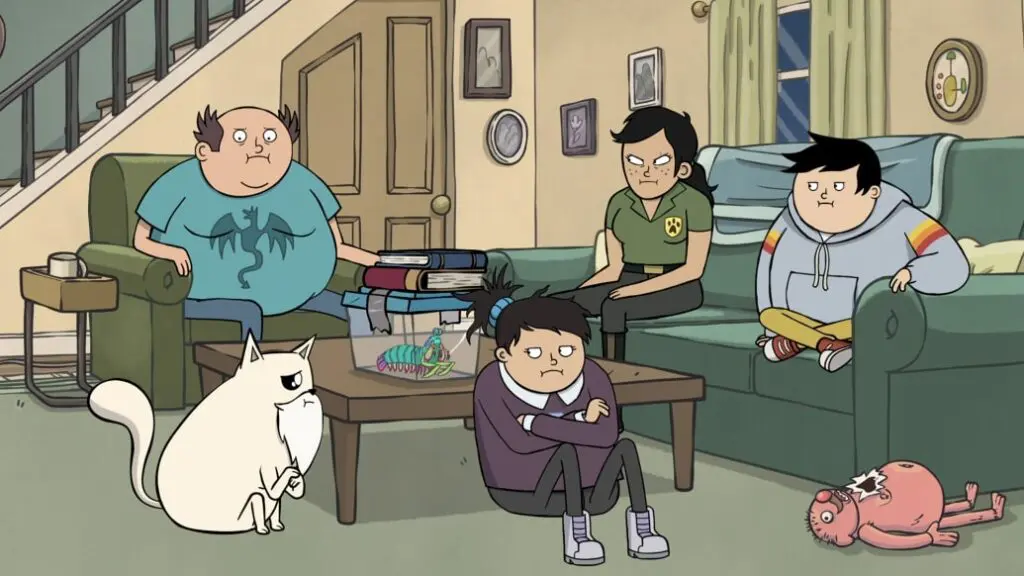
The household Godcat and Devilcat meddle with, the Higgins household, is home to an interesting family of four. Marv, an avid tabletop gamer whose day job is at a big bulk store, Abbie, a former Navy SEAL, Greta, a scientific sister who can often be the voice of reason, and Travis, a passionate content creator trying to retroactively undo his online reputation of being in an embarrassing viral video. These four are quirky on paper and have loads of character building potential, but their writing at times can be a bit sloppy and feeds into a lot of problems there are with modern animated sitcoms. A lot of the jokes come down to on-the-nose dark humor. No matter how dark the humor might get in the show, it is an adult animated series after all, the problem comes down to how shoehorned in these quips feel at times. After not even the full nine episodes of the season, that type of writing can get pretty formulaic, and in the essence of party games, the last thing you’d want is for every joke to be as predictable and played-out as it can get.
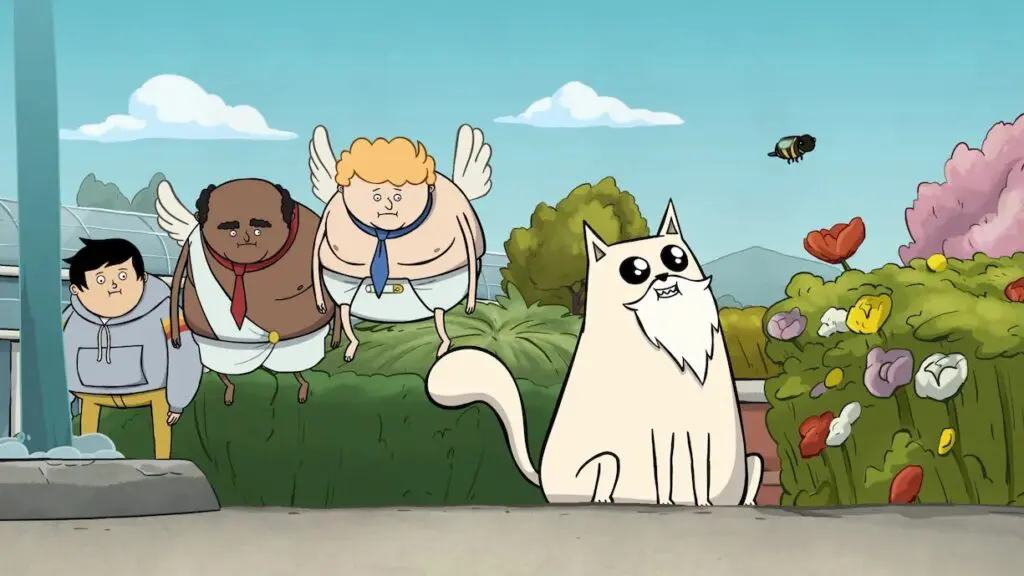
However, it doesn’t feel like these are just tortured souls that are vessels for Godcat and Devilcat and the world around them to toss around like toys. There are occasionally actual stakes with interest and plot backing to drive them. Travis’ constant talk about the internet and online content creation often feels dated and like there’s no commentary behind it (which, honestly, is hard for almost every animated sitcom to do right), but when he and Marv travel back in time to try and stop his viral video from being made, you can feel some of the regret and embarrassment he feels that isn’t just exclusive to the online experience. When he finally discovers the identity of his most relentless online troll, it doesn’t exactly feel the most crushing, but it most certainly doesn’t feel empty. The writers are trying to do something more with these characters than it would seem, which is a great direction for this series to take that isn’t just “another animated sitcom”, which works to their benefit.
Again, there isn’t a ton that’s Exploding Kittens-y about the Exploding Kittens TV show, but it’s not like they’re not trying with anything but the series name alone. Some of the cats’ expressions mirror that which appears on the cards, with more cards’ elements (such as Marv’s boss) being incorporated as well. In addition, the original artist of the game is heavily involved in the show’s production, so it doesn’t feel like an attempt to revive an IP that makes people go, “Oh, that game? It got a TV show? NOW?” You could actually make the argument that this show represents the output of the titular company BEHIND Exploding Kittens, as Marv plays a game in one episode that seems strikingly similar to another of their releases. The series is by no means a love letter to the game, but it is doing its best with what it has and comes out just fine. Which, given the factors at hand here, is an achievement worth stating. Exploding Kittens isn’t going to light the world on fire like it once had, but this is a series worth watching if you have fond memories of the game or if you just like cats. Don’t worry, there wasn’t a single kitten that actually exploded in this series.
Exploding Kittens is now available to stream on Netflix.

To start, it needs to be said that it’s hard to expect anything but the bare minimum for some of Netflix’s animated releases. Some of the service’s releases (such as Vivo, The Mitchells vs. The Machines, Nimona) are picked up from other companies that are pouring much more love into their craft than thinking about having to get a film out on a certain date. Netflix is certainly more than capable of distributing excellent animated features, but often gets a bad rap for the output of quantity-over-quality films it’s often pushed for. Speaking of which, Saving Bikini Bottom: The Sandy Cheeks Movie not only harms the reputation of Netflix’s better animated films, but the Spongebob franchise as a whole.
Upon the announcement of several Spongebob character films being greenlit for a streaming release in 2022, responses were understandably mixed. Saturation of the franchise was a common fear at the time, especially with the polarizing reception of the television spinoffs Kamp Koral: Spongebob’s Under Years and The Patrick Star Show, the former of which just recently finished its two-season run. Part of what made Spongebob so universally enjoyable early on was how far it could push its premise on television and in theaters without needing multiple series to do so. Following the messy release of the sponge’s third film Sponge on the Run in 2020, most wrote off the series as having lost its charm and direction, trying to figure its identity out again with flanderized characters and unengaging premises.
However, this announcement’s potential being drowned out by a vocal reluctant crowd failed to allow others to see the bigger picture. This could be a great soft reboot of the franchise’s direction, allowing for new worldbuilding and storylines to take form. Maybe a break from Spongebob himself while focusing on the other main characters would help usher the franchise back into shape.
Don’t get your hopes up.

It would be one thing if the problems started and ended with the somewhat stiff animation and the off-model appearance of some of the characters. And again, this is something I can often find reasoning for with the budget almost certainly being lower than the other Spongebob films that have released. I think what makes this in particular so jarring is that there’s proof these characters can work better in 3D than this film implies, and have well into the past. The Spongebob Movie: Sponge Out of Water released nearly ten years ago from this new film, and proved that when given the time and effort the franchise deserves, the characters can take shape in 3D while retaining their expressiveness greatly. 2020’s Sponge on the Run perfects this approach as well; in spite of that film’s writing and pacing flaws, the visuals are absolutely gorgeous and the best the series has ever looked in 3D. The visuals of Saving Bikini Bottom are such a dramatic step back that the entire game almost feels like a long cutscene out of one of the sponge’s early platformer video games, with the only thing breaking that immersion being the incorporation of live-action elements.

Let’s not act like the presence of live-action harms this film in concept. Every single Spongebob film has incorporated live-action to some degree, whether as memorable as Shell City in The Spongebob Squarepants Movie or whatever the hell that Snoop Dogg scene was in Sponge on the Run. The execution of these scenes varies in quality, though I fear it’s only gone downhill since the release of the first film in 2004. To the film’s credit, I think Sandy’s reasoning for having traveled to Bikini Bottom is a great element to incorporate into the franchise. It surprisingly makes sense and is a great piece of worldbuilding, and it’s a question I feel like many people have passively wondered but never thought too hard on until this film.
The B.O.O.T.S. plot had a lot of potential, but its execution is home to loads of missed opportunity. Should the abduction of Bikini Bottom have been as easy as scooping a chunk of land out of the ocean? We could have seen deep-cut characters and locales such as Rock Bottom and Atlantis being studied prior to the capturing of the series’ main location, which would make sense in the context of learning the most about their bizarre way of life. Instead, the abduction happens abruptly less than ten minutes into the film, under which the stakes feel practically nonexistent as a result. The scientists in the B.O.O.T.S. facility aren’t half bad as far as direction and acting goes either, but their performances are bogged down by the sloppy visual effects of the film and the downright confusing motivations for almost every character’s actions.
With all this being said, it’s best to try to keep an open mind for the Squidward and Plankton spin-off films announced alongside this one. They’re sure to be of similar low quality and budget, but they’ll almost certainly be led and worked on by different people and be entirely different movies as a result. Almost. There is a small chance they’ll blend together with this one into a dark, nothing trilogy for America’s favorite cleaning tool turned cartoon.

Saving Bikini Bottom: The Sandy Cheeks Movie is now streaming on Netflix.

Sony’s newest release, Harold and the Purple Crayon, released to less than pleasant reception last week. The film, based on the classic children’s book of the same name, stars Zachary Levi in the title role as a grown Harold who travels to the real world with his two friends, Moose and Porcupine. Interestingly enough, the latter two are animated animals who become live-action humans upon traveling to the real world with Harold, played by Lil Rel Howery and Tanya Reynolds respectively.
Keep in mind, however, the competition. Deadpool & Wolverine released in late July to absolutely electric success appealing to both Fox and Disney Marvel fans, and is on track to break even more records than it already had in its first weekend. The disaster film Twisters is still doing extremely well given its revival of a long-dormant IP, and Inside Out 2 was reported to still be selling enough tickets this past weekend to have outsold sales of Harold and the Purple Crayon. Things are looking rough for the guy.
Columbia Pictures’ output through Sony this year has been lackluster for the most part. With the exception of June’s Bad Boys: Ride or Die, the division hasn’t distributed many big hits this year that have gotten people talking. Incidentally, the films that HAVE gotten people talking haven’t been all too good. Interestingly enough, the linked film also underperformed. Hopefully the studio will see another hit sooner rather than later when Venom: The Last Dance releases in October.
Director Carlos Saldanha isn’t new to directing animated features, being a prominent alum of the late Blue Sky Studios. However, this is his first theatrical film to incorporate live-action elements as are prominent in the film’s marketing. It seems from most reviews that Saldanha’s direction shines a bit more when it comes to fully animated features rather than hybrids. When he’s directed past films with as much expressiveness and life as Ferdinand, it’s clear his career shouldn’t be written off because of one bad egg.
Harold and the Purple Crayon is now playing in theaters.
Get Some Strange!